How much does an RV inspection cost? Price by rig type
By Bree Calloway · October 21, 2026
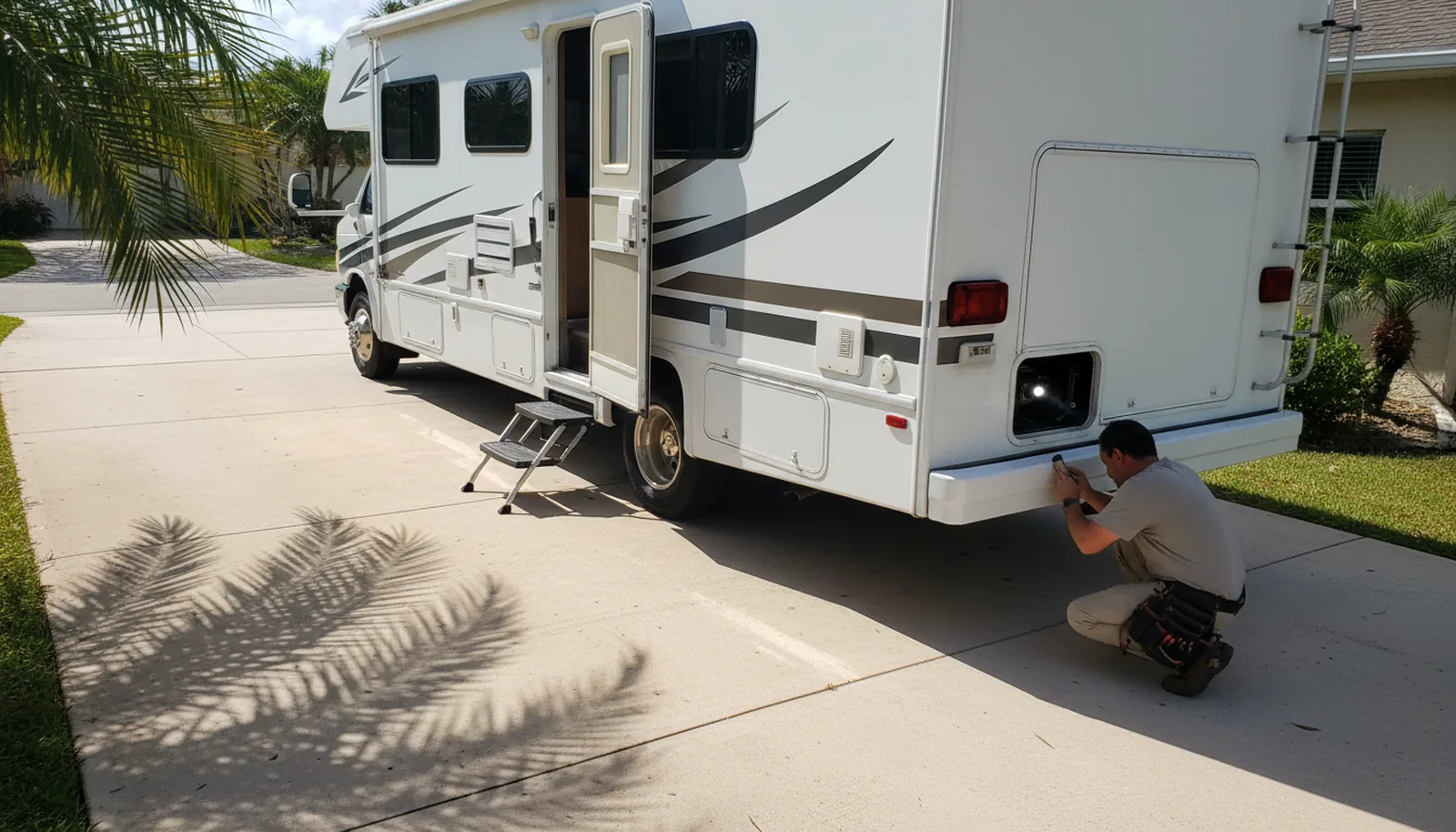
I handed a private seller $17,500 in 2019 for a fifth wheel I never had inspected. I know. Eleven months later, a soft spot I found near the front cap turned into $4,300 of rotted framing and a new fiberglass cap. That one hurt. So now every rig I buy, and every one my friends buy, gets a pre-purchase RV inspectors in Sarasota appointment before any money moves.
I call it my $17,500 tuition bill. I’d rather you spend a few hundred before you sign then four grand after. The inspection fee looks like an add-on when you’re sitting there with the cashier’s check in your hand, but it’s the cheapest line item in the whole deal.
How much does an RV inspection cost in 2026?
A pre-purchase RV inspection runs about $350 to $1,500 or more, depending on what kind of rig you’re looking at and how big it is. A small travel trailer might cost $350 to $550. A 40-foot diesel pusher with fluid samples can push $1,800 or more.
Inspectors set their own prices. I’ve seen the same 30-foot trailer quoted at $600 by one inspector and $900 by another. The two things that move the price most are the size of the rig and what you ask them to check.
My 2020 30-foot gas Class C cost $1,100 to inspect in Florida. That covered the generator load test and a roof walk with a moisture meter. Fluid analysis was not part of it.
What decides the price by RV type
The biggest driver is how much there is to look at. A pop-up has no roof AC, no slide-outs, and no holding tanks to pressure test. A 43-foot diesel pusher has fifteen systems, two air conditioners, a generator, air brakes, and a whole chassis that needs a crawl-under.
Here are typical price ranges by rig type, from published 2026 inspector price lists and consumer guides. Prices vary by market, so treat these as a starting point, not a quote:
| Rig type | What is usually included | Typical price range | Common add-ons |
|---|---|---|---|
| Travel trailer under 25 ft | Roof, exterior, frame, brakes, plumbing, electrical | $350 to $550 | Moisture meter deep scan |
| Travel trailer 25 to 35 ft | Above, plus slide-outs, more appliances | $400 to $700 | Slide seal inspection |
| Fifth wheel | Above, plus hitch, pin box, more slides, more roof | $450 to $900 | Fluid analysis (if generator) |
| Class C motorhome | Chassis, engine, cab, house systems, generator | $450 to $1,100 | Generator load test |
| Class A gas | Full coach, chassis, engine, all house systems | $500 to $1,300 | Fluid samples, roof imaging |
| Diesel pusher | Engine, air brakes, air suspension, generator, all house systems | $650 to $1,800+ | Fluid analysis (engine, trans, coolant, generator) |
A longer rig means more roof to walk, more wall to scan, more windows to check, and more time on the ground under it.
I found a helpful video that breaks down inspection costs and what inspectors actually check.
Inspection level and scope, not just a checklist
Most inspectors offer a basic walkthrough and a full standards-based inspection. The basic tier might cover propane leak-down, outlets, water heater, and a roof walk, but skip the generator load test or the slide mechanism torque check.
A full NRVIA-style inspection is still visual and functional, not technically exhaustive, but it follows a written standard that covers the roof, exterior, electrical, plumbing, propane, appliances, interior, and chassis for motorhomes.
Before you book, ask exactly what the inspector will do and what they will not do. Get it in writing.
My $1,100 Class C inspection covered the roof, slides, generator, all appliances, plumbing pressure test, and propane leak test. It did not cover the engine beyond a visual check. The written scope said that up front, so I also paid a seperate mobile mechanic $180 to check the engine and transmission. Our post on RV inspection add-ons: which extras are worth paying for, honestly walks through what is and isn’t worth the money.
Travel distance and trip fees
Inspectors travel to the RV, whether it’s on a dealer lot, in a storage yard, or in the seller’s driveway. Most include a free radius of 25 to 50 miles from thier home base. Beyond that, expect to pay $0.50 to $2.00 per mile or a flat zone fee.
A 60-mile round trip might add $50 to $100 or more to your quote, depending on the inspector’s per-mile rate. Search for pre-purchase RV inspectors nationwide and ask about travel fees on you’re first call.
When I bought my Class C, the inspector lived 32 miles from the seller’s house in Bradenton. His $1,100 quote included travel. If the rig had been outside his 50-mile radius, the trip fee woudl have been $1.50 a mile each way, which is within the typical range. I asked before I booked because I hate surprise line items.
Add-ons that change the price quickly
Fluid analysis is the add-on I wish I had paid for on a diesel. The inspector draws small samples of engine oil, transmission fluid, and coolant, maybe generator oil and hydraulic fluid, and sends them to a lab. Expect to pay about $200 to $300 for the fluid analysis, on top of the base inspection.
A generator load test might be included in a full inspection or be an add-on; ask for the price. It tells you the generator produces power under load, not just that it fires up and sounds fine in the driveway.
Roof imaging with a drone or infrared camera is newer and prices vary all over the place. I have not paid for it. A good inspector with a moisture meter and eyes catches most roof problems, in my experience. If the roof is 40 feet long and you’re buying a 15-year-old coach, it might be worth the extra.
Ask for a written list of what each add-on costs and what it includes before you book, so you can decide with your head, not your excitement.
Why a cheap quote can be the most expensive one
I have seen a cheap report that said ‘roof: good’ with no mention of lap sealant condition, no photos, and no moisture meter readings. A few months later the buyer found the roof seam was open above the slide-out, right where the the report said everything was fine.
A full inspection on a 30-foot trailer can take four to six hours on site, plus a few hours writing the report. If an inspector quotes $150 and promises to be done in an hour, the math doesn’t work, it just doesn’t.
Compare what you get for the price, not just the number. Our post Cheap RV inspection vs a full inspection, honestly shows the difference in what you get for your money. I’d rather pay $700 for a written report with photos and moisture readings than $200 for a one-page walkaround that tells me nothing.
Who pays, and never let the seller pick the inspector
The buyer usually pays for the pre-purchase inspection.
Do not let the seller hire the inspector. Do not let the seller pay the inspector directly. I know a buyer who used the seller’s ‘mobile tech guy’ for a pre-purchase check, and the report missed a soft floor and a dead slide motor. That ‘inspection’ cost $150. The repairs later cost $2,800, and the seller was long gone by then.
Hire your own inspector, pay them yourself, and get the report directly. If the seller objects, there’s usually a reason. Ask the inspector if they have any financial interest in the sale or the rig. Ask for proof of insurance. A certified inspector should carry liability coverage and give you a sample report before you book, so you can see if it’s something you can actualy understand.
The $4,300 inspection I should have paid for
On my Class C, I spent $1,100 before I signed the paperwork. The inspector flagged a cracked battery tray, a weak GFCI, and a slide seal that needed replacement. The seller fixed the first two and knocked $300 off the price for the third. That check paid for itself before I drove it home.
If you’re looking at a used rig this month, pull up two or three certified inspectors near you, tell them the exact year, make, model, and length, and ask for a written quote with the scope spelled out. Then book the one whose report samples you can actually read and make sense of. If you’re in my part of Florida, I keep a list of pre-purchase RV inspectors in Sarasota who have caught problems for readers. But no matter where the RV is, spend an hour comparing quotes before you fall in love with the floor plan. The floor plan won’t fix a rotted frame.
Related reading
FAQ
How much does an RV inspection cost?
A pre-purchase RV inspection usually costs $350 to $1,500 or more. A small travel trailer might be $350 to $550, a fifth wheel $450 to $900, a Class C $450 to $1,100, and a diesel pusher $650 to $1,800 or more. Add-ons like fluid analysis and generator load tests add a few hundred dollars, and travel beyond 25 to 50 miles adds a per-mile fee.
Who pays for the RV inspection when buying from a dealer?
The buyer usualy pays. Some dealerships might apply the inspection cost toward the purchase if you close, but don't count on that. Never let the dealer choose the inspector or pay the inspector directly. You want the inspector working for you, with no financial tie to the sale.
Is a cheaper RV inspection just as good?
Usually not. A $199 inspection may skip the propane leak test, hot-skin check, water pressure test, or the generator load test. A full standards-based inspection on a mid-size rig can take 4 to 6 hours on site. If the quote is cheap and fast, ask exactly what is on the checklist and what is not, because a thorough inspection takes time.
What does a full RV inspection include?
A full NRVIA-style inspection covers the roof, exterior, frame, brakes, electrical, plumbing, propane, appliances, interior, and chassis for motorhomes. It includes a propane leak-down test, hot-skin check, water pressure test, air conditioner temperature split, slide operation, and moisture meter scans. The inspector documents everything with photos and a written report.
Should I get a fluid analysis on a used motorhome?
For a diesel pusher or gasoline coach with high miles, yes. Lab analysis of engine oil, transmission fluid, and coolant costs about $200 to $300 and can flag coolant in the oil, fuel dilution, or abnormal wear metals. One sample is a snapshot, but a bad result can save you a $10,000 repair. For a gas Class C under 50,000 miles, it's optional.
How long does an RV inspection take?
On site, a small trailer can take 2 to 4 hours; a mid-size motorhome can take 4 to 6 hours; a large diesel pusher can take 8 to 10 hours or more. The report writing offen adds a few hours after the visit. Many inspectors deliver the report within 24 to 48 hours, with photos and a summary of findings, but ask before booking.
Does a dealer pre-delivery inspection replace an independent inspection?
No. A dealer PDI is done by the selling dealer's techs, who work for the dealer, not you. An independent inspector has no financial interest in the sale and no incentive to hide problems. Independent inspections of new units still find issues like roof damage, missing GFCI protection, and appliances that don't work.
Find RV inspectors near you
Compare independent RV inspectors in your city, then ask a few for a price before you buy.
Browse by stateOr jump to: Austin, TX · Oklahoma City, OK · Ocala, FL