Where to get an RV propane cylinder requalified (and when you need to)
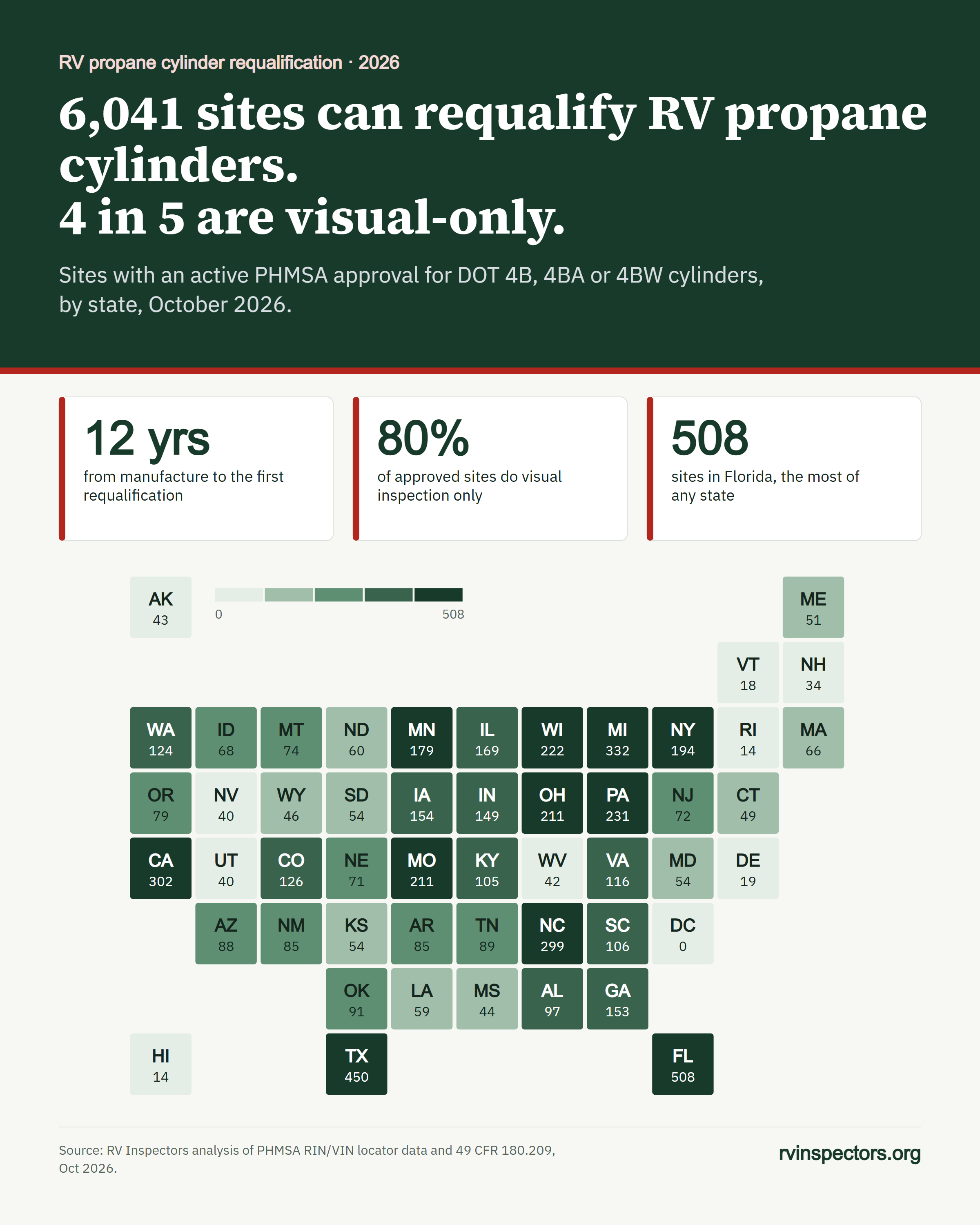
We pulled every active approval from PHMSA's public requalifier locator and kept the 6,041 US sites approved for DOT 4B, 4BA and 4BW cylinders, the specifications that cover portable LP cylinders. Four in five can only do the 5-year visual inspection. Every cylinder needs its first requalification 12 years after the manufacture date on its collar.
By the RV Inspectors research desk · Published October 25, 2026
Key findings
- 6,041 sites in 50 states hold an active PHMSA approval covering DOT 4B, 4BA or 4BW cylinders. We found none with a District of Columbia address.
- 80% are visual-only. 4,818 sites can do the 5-year external visual inspection only, 1,132 can only pressure-test, and 91 can do both.
- Florida (508), Texas (450) and Michigan (332) have the most sites; Hawaii and Rhode Island have the fewest, with 14 each. The median state has 85.
- The first deadline is 12 years from manufacture. After that a visual inspection buys 5 years, a proof pressure test 10 and a volumetric expansion test 12 (49 CFR 180.209).
- An overdue cylinder cannot be refilled, but one filled before its due date may be used until it is empty (49 CFR 180.205).
- Exchange is the shortcut for grill-size tanks. Blue Rhino and AmeriGas both say their exchange cylinders are requalified as part of the process.
When an RV propane cylinder is due
The portable cylinders on travel trailers and fifth wheels are DOT specification cylinders, usually DOT 4BA or 4BW. Federal rules in 49 CFR 180.209 give a coated cylinder in LP service 12 years from its manufacture date. After that it has to be requalified by a business holding a PHMSA approval before it can be refilled. The method chosen sets the next deadline.
| First requalification | 12 years from manufacture | None (manufacture date only) | A coated cylinder in non-corrosive service such as LP may wait 12 years instead of 5 before its first requalification. | 49 CFR 180.209(e) |
| External visual inspection | Every 5 years | E, or a V-number | Done to CGA C-6 by a holder of a current RIN or visual inspection number. Allowed for LP that meets ASTM D1835 limits. | 49 CFR 180.209(g); 180.213(f)(5), (g) |
| Proof pressure test | Every 10 years after the first 12 | S | Test at least two times the marked service pressure; the cylinder is examined under pressure and removed if it leaks. | 49 CFR 180.209(e); 180.213(f)(4) |
| Volumetric expansion (hydrostatic) test | Every 12 years | None | Water-jacket style test; the stamp shows the date and requalifier ID with no letter. | 49 CFR 180.209(e); 180.213(f)(1) |
| Filling an overdue cylinder | Not allowed | n/a | No cylinder may be filled and offered for transport unless requalified. A cylinder filled before it fell due may stay in service until emptied. | 49 CFR 180.205(c) |
| Damaged cylinder | Before further use | n/a | Dents, corrosion, cracks, leaks, fire or heat damage, or accident damage require test and inspection regardless of the date. | 49 CFR 180.205(d) |
| Who may requalify | n/a | RIN in a square between month and year | Only a person holding a current PHMSA approval may mark a requalification. Approval needs a review by an independent inspection agency. | 49 CFR 180.205(b); PHMSA |
Rules as published in the eCFR, read 2026-10-25. Several older owner guides give 7 years for the proof pressure test; the current text says 10 for these cylinders. Download this table (CSV)
Where the requalifiers are
Florida, Texas and California sit near the top, as their size would suggest, but the order is not a population ranking. Florida's total is lifted by 344 sites approved for pressure testing, far more than any other state. Michigan has more sites than California, and rural states such as Montana (74), North Dakota (60) and Wyoming (46) have more than their population alone would suggest.
For most RV owners the visual inspection is the one that matters: it is permitted for LP cylinders, it is the most widely available, and it is the method behind the E stamps common on requalified tanks. A cylinder with rust pitting, dents or a damaged foot ring may be rejected at the visual and must then be pressure-tested, repaired or condemned, which is why the smaller pool of pressure-test sites matters too.
| Alabama | 97 | 81 | 19 |
| Alaska | 43 | 37 | 8 |
| Arizona | 88 | 76 | 14 |
| Arkansas | 85 | 77 | 9 |
| California | 302 | 236 | 72 |
| Colorado | 126 | 112 | 16 |
| Connecticut | 49 | 35 | 14 |
| Delaware | 19 | 16 | 5 |
| District of Columbia | 0 | 0 | 0 |
| Florida | 508 | 168 | 344 |
| Georgia | 153 | 126 | 31 |
| Hawaii | 14 | 11 | 6 |
| Idaho | 68 | 64 | 4 |
| Illinois | 169 | 136 | 34 |
| Indiana | 149 | 124 | 28 |
| Iowa | 154 | 141 | 14 |
| Kansas | 54 | 51 | 6 |
| Kentucky | 105 | 89 | 18 |
| Louisiana | 59 | 41 | 24 |
| Maine | 51 | 42 | 9 |
| Maryland | 54 | 42 | 13 |
| Massachusetts | 66 | 43 | 25 |
| Michigan | 332 | 306 | 27 |
| Minnesota | 179 | 169 | 10 |
| Mississippi | 44 | 37 | 7 |
| Missouri | 211 | 194 | 19 |
| Montana | 74 | 71 | 4 |
| Nebraska | 71 | 63 | 8 |
| Nevada | 40 | 37 | 6 |
| New Hampshire | 34 | 26 | 9 |
| New Jersey | 72 | 47 | 28 |
| New Mexico | 85 | 80 | 5 |
| New York | 194 | 136 | 61 |
| North Carolina | 299 | 266 | 34 |
| North Dakota | 60 | 55 | 5 |
| Ohio | 211 | 172 | 41 |
| Oklahoma | 91 | 86 | 7 |
| Oregon | 79 | 66 | 16 |
| Pennsylvania | 231 | 190 | 45 |
| Rhode Island | 14 | 9 | 5 |
| South Carolina | 106 | 91 | 15 |
| South Dakota | 54 | 51 | 3 |
| Tennessee | 89 | 79 | 12 |
| Texas | 450 | 389 | 67 |
| Utah | 40 | 35 | 6 |
| Vermont | 18 | 17 | 1 |
| Virginia | 116 | 103 | 18 |
| Washington | 124 | 110 | 16 |
| West Virginia | 42 | 37 | 6 |
| Wisconsin | 222 | 194 | 28 |
| Wyoming | 46 | 45 | 1 |
A site with both approval types appears in both columns, so they can add up to more than the total. Download this table (CSV)
How to read the stamp on your cylinder
- Find the collar. The manufacture date is stamped into the ring around the valve as month and year. Blue Rhino notes the requalification date is usually on the edge of the collar.
- Look for a later stamp. A requalification mark has the month on the left, the requalifier's four-character RIN set in a square, and the year on the right. In the example in 49 CFR 180.213, a cylinder requalified in September 2006 by RIN A123 shows 9, then A1 over 32, then 06.
- Read the letter. E means a 5-year visual inspection, S means a 10-year proof pressure test, and no letter means a 12-year volumetric expansion test. A visual-only requalifier may stamp its visual inspection number (for example V123456) instead of a RIN.
- Add the interval to the newest date. That is the month after which the cylinder cannot be refilled.
- Check the requalifier. You can look up any RIN or V-number in the PHMSA locator.
Exchange is an alternative
Cylinder exchange programs swap an empty tank for a filled one, and the exchange company takes on requalification. Blue Rhino says it requalifies tanks as part of its process. AmeriGas says a tank from its exchange program has already been recertified. Both programs are built around the standard grill-size tank; Blue Rhino accepts "any standard empty grill tank." Owners of 30- or 40-lb RV cylinders should plan on requalifying their own.
What it means for you
- Read both collars now. If the newest date plus its interval falls this season, get it done before a trip, not at a fill station that turns you away.
- Search the PHMSA locator by city or ZIP. It lists each site's approval type and the cylinder specifications it covers. Call ahead to ask whether the site requalifies 4BA or 4BW cylinders for the public and what it charges.
- Expect a rusty cylinder to fail. Pitting, dents and a bent foot ring can get a cylinder rejected at the visual inspection. Price a new cylinder before paying for a pressure test on a bad one.
- Buying a used trailer? Expired cylinders are easy to miss on a rig that has been sitting. A pre-purchase RV inspection or a dedicated RV propane inspection records the dates and leak-tests the system. Mobile RV inspectors can do it where the rig is parked.
- Motorhome owners: a mounted ASME tank is not on this schedule. Our RV expiration dates chart covers it and the other dates hidden on a rig, and our state rules guide covers state inspection requirements.
The infographic
Free to use with a link. Publish the graphic or the numbers anywhere, as long as you credit RV Inspectors with a link to this page.
How we did this
- On 2026-10-25 we queried PHMSA's public RIN/VIN locator (the same search the locator page runs) over a grid of 200-mile circles covering the 50 states, DC and Puerto Rico, and removed duplicates by site ID. That returned 6,850 sites with active approvals, 6,731 of them in the 50 states and DC.
- We kept sites whose approval lists a DOT 4B-family specification (4B, 4BA, 4BW, including the 240 variants): 6,041 sites. A site counts once even if it holds several approvals. Visual means the CYLINDER REQUALIFIER (VISUAL) class; pressure test covers hydrostatic and the small number of ultrasonic, acetylene and mobile approvals.
- The locator lists approvals, not services offered to the public. Some sites may requalify only their own or their customers' cylinders, and a site without map coordinates would not appear in a distance search. Treat the counts as a floor and call ahead.
- Rules come from the eCFR text of 49 CFR 180.205, 180.209 and 180.213 as of 2026-10-25. PHMSA's requalifier page names the locator as the search tool; we found no downloadable list.
- Exchange program statements come from the Blue Rhino and AmeriGas websites. We did not test either program and we do not rank businesses.
Not legal advice. Laws and agency rules change. Each row links the source we read and the date we checked it; confirm with the agency or an attorney before you rely on it.
Sources
- eCFR, 49 CFR 180.209, Requirements for requalification of specification cylinders, accessed October 25, 2026
- eCFR, 49 CFR 180.205, General requirements for requalification of specification cylinders, accessed October 25, 2026
- eCFR, 49 CFR 180.213, Requalification markings, accessed October 25, 2026
- PHMSA, Cylinder Requalifiers, accessed October 25, 2026
- PHMSA, RIN/VIN Locator Tool, accessed October 25, 2026. Source of the site counts
- Blue Rhino, Where can I find the date on my tank?, accessed October 25, 2026
- Blue Rhino, Is my tank acceptable for exchange?, accessed October 25, 2026
- AmeriGas, Propane tank recertification, accessed October 25, 2026
Cite this: RV Inspectors, "Where to get an RV propane cylinder requalified (and when you need to)," October 25, 2026, https://rvinspectors.org/propane-tank-requalification/
Spotted an error or have newer data? Tell us and we'll check it and update the page.
Questions people ask
How often does an RV propane cylinder need to be requalified?
The first requalification is due 12 years after the manufacture date stamped on the collar. After that, a visual inspection is good for 5 years, a proof pressure test for 10 years and a volumetric expansion test for 12 years, under 49 CFR 180.209.
Who can requalify a propane cylinder?
Only a business holding a current PHMSA approval, shown by a RIN or a visual inspection number. We counted 6,041 US sites approved for DOT 4B, 4BA or 4BW cylinders in October 2026. PHMSA's online locator finds them by city or ZIP and shows what each is approved to do.
Can I get an expired propane tank filled?
No. Federal rules bar filling a cylinder that is past its requalification date, though one filled before it fell due may be used until it is empty. Get it requalified, exchange it if it is a grill-size tank, or replace it.
What does the E on my propane tank mean?
An E after a date and requalifier ID means the cylinder passed an external visual inspection. That requalification lasts 5 years. An S means a proof pressure test, good for 10 years, and no letter means a volumetric expansion test, good for 12 years.
Is exchanging a tank the same as requalifying it?
Not quite. With Blue Rhino or AmeriGas exchange you hand over your tank and get a filled one that the company says it has requalified as needed. Your old tank is not returned. Exchange is built for standard grill-size tanks, so larger RV cylinders usually need requalifying.