The hidden expiration dates in your RV: a date-code chart
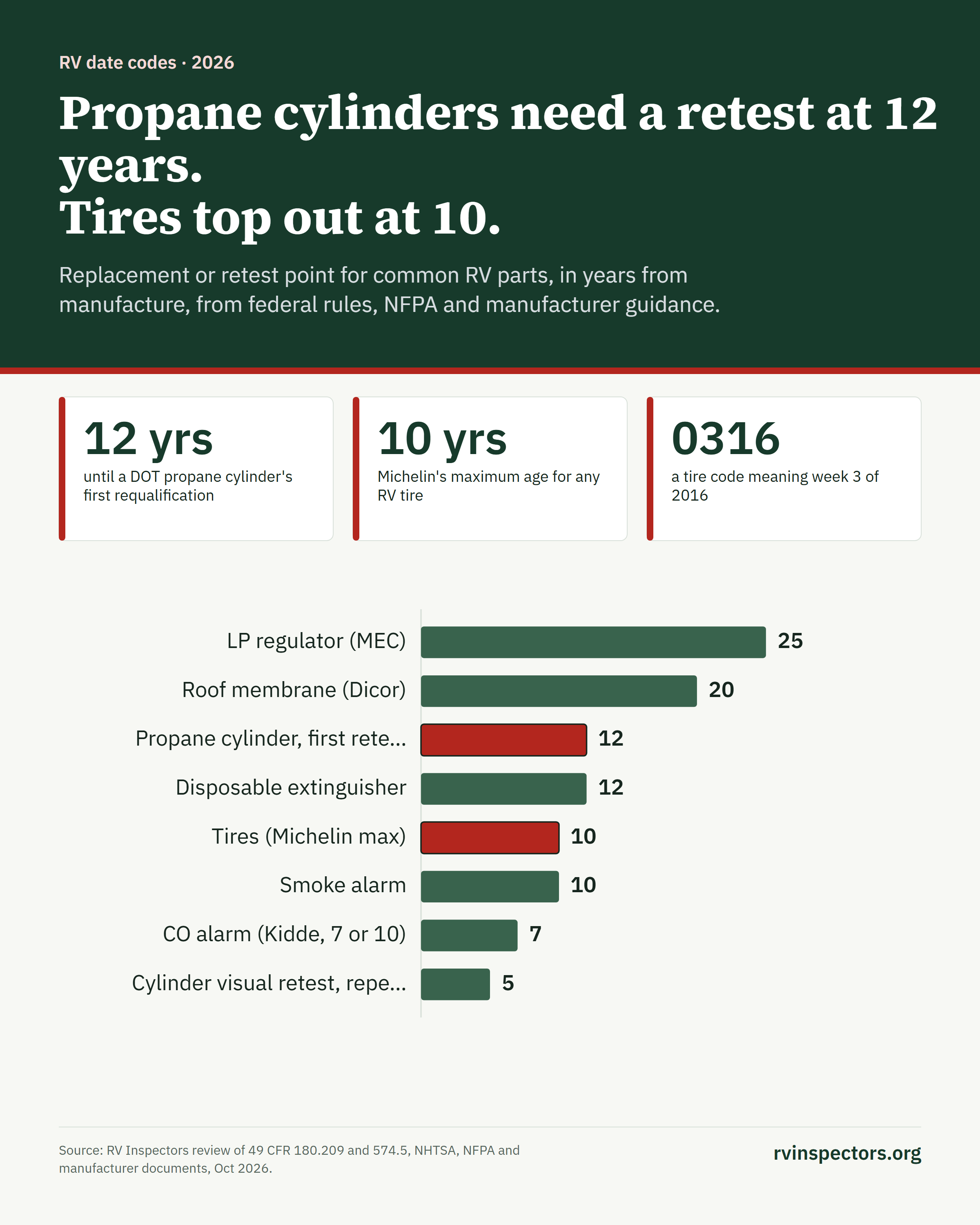
We pulled the date rules for 13 parts of a typical RV from federal regulations, NFPA guidance and manufacturer documents. The two that catch most buyers: a DOT propane cylinder cannot legally be refilled once it passes 12 years from manufacture without requalification, and Michelin says to replace any RV tire at 10 years, whatever the tread looks like.
By the RV Inspectors research desk · Published October 25, 2026
Key findings
- Propane cylinders run on a 12-year clock. A DOT 4B, 4BA or 4BW cylinder in LP service must be requalified 12 years after its manufacture date, then every 5, 10 or 12 years depending on the method (49 CFR 180.209).
- Tires age out before they wear out on many RVs. NHTSA notes that some vehicle and tire makers recommend replacing tires at six to 10 years old; Michelin's RV bulletin says 10 years at most, with yearly inspections after year five.
- The tire date is four digits, week then year. A DOT code ending in 0316 means the third week of 2016 (49 CFR 574.5).
- Disposable fire extinguishers come out of service at 12 years from the date of manufacture under NFPA 10; rechargeable dry-chemical units need a 6-year internal exam and a 12-year hydrostatic test.
- Smoke alarms last 10 years, per NFPA. CO alarm life is set by the maker: Kidde rates its CO alarms at 7 or 10 years.
- Marshall Excelsior rates its Excela-Flo regulators for a 25-year recommended replacement life, sooner if inspection shows wear. We could not find a published interval from Camco.
The date-code chart
Most of the dates that matter on an RV are stamped, molded or printed somewhere you would not look on a walk-through. The table lists where each one hides, how to decode it and what the rule or manufacturer says to do. Where we could not confirm a figure from a primary source, the cell says so.
| Tires (including the spare) | Sidewall, at the end of the DOT Tire Identification Number. It may be on one side only. | Last four digits are week and year: 0316 = week 3 of 2016. | Some makers say 6 to 10 years. Michelin: annual specialist inspection after 5 years in use, replace at 10 years maximum. | NHTSA; 49 CFR 574.5; Michelin bulletin |
| DOT propane cylinder (20, 30, 40 lb) | Stamped into the collar (the ring around the valve). | Manufacture date as month-year, for example 05-14. A later requalification stamp shows month, the requalifier's ID and year, plus a letter: E = visual, S = proof pressure. | Requalify 12 years after manufacture. Then every 5 years (visual), 10 years (proof pressure) or 12 years (volumetric expansion). | 49 CFR 180.209; 49 CFR 180.213 |
| ASME motorhome propane tank | Data plate on the tank body. | Plate shows the ASME code mark, maker, serial number and year built. | No requalification interval: 49 CFR 180.209 covers DOT specification cylinders only. Inspect for rust, pitting, damaged brackets and valve leaks at every LP check. Fixed interval: Not confirmed. | 49 CFR 180.209 |
| LP regulator | Date code stamped or printed on the regulator body or bonnet. | Format varies by maker; look for a month and year. | Marshall Excelsior: replace Excela-Flo regulators at 25 years from manufacture, sooner if inspection shows the need or the unit has been flooded. Camco interval: Not confirmed. | MEC catalog |
| LP leak detector | Label on the back of the unit (wall-mounted near the floor). | Manufacture or replace-by date printed on the label. | Replace by the label date or when the end-of-life signal sounds. A single industry-wide figure: Not confirmed. | Not confirmed: manufacturer label |
| CO alarm | Back of the alarm. | Manufacture date on the label. | Replace on the maker's schedule. Kidde CO alarms signal end of life at 7 or 10 years with a chirp every 30 seconds. | NFPA; Kidde |
| Smoke alarm | Back of the alarm. | Manufacture date on the label. | Test monthly, replace every 10 years. | NFPA |
| Fire extinguisher, disposable | Date code printed or stamped on the cylinder. | Manufacture date (format varies by maker). | Remove from service 12 years from the date of manufacture. Check the gauge and seal monthly. | NFPA 10, via Minnesota Dept. of Health |
| Fire extinguisher, rechargeable dry chemical | Service tag (maintenance) and hydrostatic test label. | Tag shows month and year of last maintenance; the test label is punched with month and year. | Monthly visual check, annual maintenance, 6-year internal exam, 12-year hydrostatic test. | NFPA 10, via Minnesota Dept. of Health |
| Roof sealant and membrane | No date. Ask for service records. | Look for cracked, shrinking or lifting sealant at seams, vents and edges. | Keystone: inspect the roof every 3 months, all exterior seals at least twice a year. Dicor: clean the roof at least 4 times a year; a maintained membrane should last at least 20 years. | Keystone RV; Dicor FAQ |
| House batteries (flooded lead-acid) | Date sticker or code on the case; formats vary by brand. | Not standardized. Ask the seller for the install date. | Trojan: check water levels monthly after installation. Replacement age: Not confirmed (depends on use and charging). | Trojan Battery |
| Generator (Cummins Onan) | Hour meter on the generator or remote panel. | Hours run since new. | Oil change at the model's hour interval (50 to 500 hours depending on model), or annually if it runs fewer hours. | Cummins RV parts chart |
| Chassis coolant and brake fluid (motorhomes) | Chassis maintenance records; no date on the parts. | Compare the last service date with the chassis schedule. | Varies by chassis maker and coolant type. A single interval: Not confirmed. | Not confirmed: chassis owner's manual |
Intervals compiled October 2026. Always follow the label on the part itself when it is stricter. Download this table (CSV)
How long each item lasts, in years
The propane cylinder clock, in detail
Under 49 CFR 180.209, a coated DOT 4B, 4BA or 4BW cylinder in LP service gets 12 years from its manufacture date before the first requalification. After that the owner has three routes: an external visual inspection, good for 5 years and marked with an E; a proof pressure test, good for 10 years and marked with an S; or a volumetric expansion test, good for 12 years. Section 180.205 bars filling a cylinder that is out of date, though one filled before its due date may be used until empty.
Our guide to propane cylinder requalification covers how to read the stamp, who is allowed to do the work and how cylinder exchange fits in. A mounted ASME tank on a motorhome is a different vessel and is not on this federal schedule, which is one reason a motorhome inspection checks the tank, brackets and relief valve by eye.
What it means for buyers and owners
- Before you buy a used RV, read the tire codes and the cylinder collars yourself. Six old tires and two expired cylinders are a negotiating point worth real money. A pre-purchase RV inspection should record every date on this chart.
- Count the spare. NHTSA singles out spares as prone to aging because they are seldom replaced.
- Do not trust a gauge alone on an extinguisher. The date, the seal and the weight matter as much as the needle.
- Ask for roof records. Dicor roof warranties go to the original purchaser only and cannot be transferred, so a second owner relies on the roof's condition, not its paperwork. A roof inspection is the check that counts.
- Have the LP system leak-tested when you buy and after any regulator or hose change. An RV propane inspection covers the regulator, lines, detector and cylinders in one visit.
- Check your state's rules in our state-by-state RV inspection guide; some states require periodic safety inspections of motorhomes or trailers.
Printable checklist
Print this page or download the table as a CSV and take it on your walk-through. Write the date you find next to each line.
- Tires: read the last four digits of the DOT code on every tire and the spare. Flag anything over 6 years; plan to replace at 10.
- Propane cylinders: read the collar stamp. Is the newest date (manufacture or requalification) still inside its 12, 5, 10 or 12-year window?
- ASME tank (motorhomes): check the data plate, brackets and surface rust; look for leaks at the valves.
- LP regulator: find the date code; note any venting, frost or rust.
- LP leak detector: read the replace-by date on the back; press test.
- CO alarm: read the manufacture date; press test.
- Smoke alarm: read the manufacture date; replace if over 10 years.
- Fire extinguisher: read the date, gauge and seal; disposable units out at 12 years.
- Roof: look at sealant around every vent, seam and edge; ask when it was last resealed.
- Batteries: note the date sticker; check water levels on flooded batteries.
- Generator: write down the hour meter reading and ask for the oil-change log.
- Chassis (motorhomes): ask for coolant and brake fluid service records.
The infographic
Free to use with a link. Publish the graphic or the numbers anywhere, as long as you credit RV Inspectors with a link to this page.
How we did this
- We compiled the table in October 2026 from the current eCFR text of 49 CFR 180.205, 180.209, 180.213 and 574.5 (read 2026-10-25), NHTSA and USTMA tire guidance, NFPA public guidance, and manufacturer documents from Michelin, Marshall Excelsior, Kidde, Keystone RV, Dicor, Trojan Battery and Cummins.
- NFPA 10 intervals are taken from a Minnesota Department of Health guide that cites the 2010 edition section by section, because the standard itself is not free to read. NFPA 1192, the RV standard, is also paywalled, so we did not cite it.
- Where a manufacturer published no interval we could open (Camco regulators, LP leak detectors, chassis coolant and brake fluid, battery replacement age), the cell says Not confirmed rather than repeating figures from forums.
- The Michelin bulletin is Michelin's own May 2018 technical bulletin; the copy we read is hosted on a third-party site.
- The bar chart shows the upper limit each source gives. It is not a prediction of how long a given part will last.
Sources
- eCFR, 49 CFR 180.209, Requirements for requalification of specification cylinders, accessed October 25, 2026
- eCFR, 49 CFR 180.205, General requirements for requalification, accessed October 25, 2026
- eCFR, 49 CFR 180.213, Requalification markings, accessed October 25, 2026
- eCFR, 49 CFR 574.5, Tire identification requirements, accessed October 25, 2026
- NHTSA, Tires (TireWise): Aging, accessed October 25, 2026
- USTMA, Tire facts: tire service life, accessed October 25, 2026
- Michelin technical bulletin, Service Life for RV/Motorhome Tires (May 2018), accessed October 25, 2026. Third-party copy of the Michelin bulletin
- Marshall Excelsior (MEC) LP-Gas & NH3 Equipment Catalog 2020-2021, accessed October 25, 2026
- NFPA, Smoke alarms, accessed October 25, 2026
- NFPA, Carbon monoxide safety, accessed October 25, 2026
- Kidde, Carbon monoxide detector replacement FAQs, accessed October 25, 2026
- Minnesota Department of Health, Maintenance and Testing of Portable Fire Extinguishers (cites NFPA 10, 2010 ed.), accessed October 25, 2026
- Keystone RV, Exterior seal maintenance guide, accessed October 25, 2026
- Dicor Products, FAQ, accessed October 25, 2026
- Trojan Battery, Quick battery watering guide, accessed October 25, 2026
- Cummins Onan, RV generator parts and maintenance chart, accessed October 25, 2026
Cite this: RV Inspectors, "The hidden expiration dates in your RV: a date-code chart," October 25, 2026, https://rvinspectors.org/rv-expiration-dates-chart/
Spotted an error or have newer data? Tell us and we'll check it and update the page.
Questions people ask
How do I read the date on an RV tire?
Find the DOT Tire Identification Number on the sidewall and read the last four digits. The first two are the week and the last two are the year, so 0316 means the third week of 2016. The code may be on only one side of the tire, so check both.
How old is too old for RV tires?
There is no federal age limit. NHTSA notes that some vehicle and tire makers recommend replacing tires at six to 10 years old regardless of tread. Michelin says RV tires in use 5 years or more should be inspected by a specialist every year and replaced at 10 years at most.
When does an RV propane cylinder expire?
A DOT 4B, 4BA or 4BW cylinder in LP service must be requalified 12 years after the manufacture date stamped on its collar. After that, a visual requalification lasts 5 years, a proof pressure test 10 years and a volumetric expansion test 12 years. An out-of-date cylinder cannot be refilled.
Does a motorhome's built-in propane tank need recertification?
A permanently mounted ASME tank is not a DOT specification cylinder, so the 49 CFR 180.209 requalification schedule does not apply to it. It still needs regular checks for rust, pitting, loose brackets and valve leaks, which an inspector covers during a motorhome or propane inspection.
How often should an RV fire extinguisher be replaced?
Under NFPA 10, a disposable (nonrechargeable) extinguisher comes out of service 12 years after its manufacture date. A rechargeable dry-chemical unit needs annual maintenance, a 6-year internal exam and a 12-year hydrostatic test. Check the gauge, seal and placement every month either way.